Scattered poems and writings
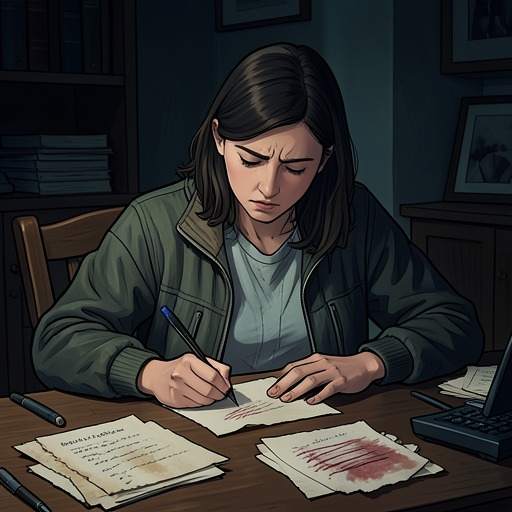
The Sky Is EverywhereLennie’s scattered poems and writings turn grief into fragments placed where the world may keep, erase, or carry them away. Written on to-go cups, wrappers, book covers, advertisements, and scraps, they let Lennie express what she cannot yet contain in ordinary conversation. Their movement from private expression to accidental discovery gives the motif its decisive force: the words preserve a record of Bailey and Lennie’s shared life, but they also become a way for Joe Fontaine to encounter Lennie through what she has left behind.
Forms and Places of the Writing
The writings are not confined to a notebook or a single intended collection. Lennie writes on a discarded to-go cup after walking home from the river through the woods, then buries it beneath pine needles. Other fragments appear inside the cover of Wuthering Heights, on a cup at Rain River, on a paper caught between rocks at Flying Man’s, and on the want ads of The Clover Gazette beneath a bench outside Maria’s Deli. A piece of paper in the stacks of the B section at Clover Public Library preserves a fragment about someone jumping up and dancing. The surfaces vary; the repeated act of leaving words behind is what links them.
That variety makes the poems materially precarious. Cups and wrappers can be discarded, paper can be buried or hidden, and writing exposed to weather can disappear. Later, Lennie recognizes that some scraps have been washed away by rain, erased by the sun, or carried off by the wind; others remain tucked between rocks, in bins, on walls, and in book margins. The fragments are therefore not a stable archive. Their survival depends on where they land and whether anyone happens upon them.
The brief inscriptions also range across different emotional registers. One fragment imagines dreams in which two people might switch bodies. Another records a promise not to disappear like Mom, while a note at Flying Man’s corrects the imagined denial of motherhood with the insistence that the speaker is on the way to see her girls. A separate scrap, found among the want ads, evokes a private understanding shared by Bailey and Lennie. These pieces do not form a continuous account; their scattered form lets moments of intimacy, longing, and family absence surface individually.
Grief, Memory, and Private Speech
The writing begins in the aftermath of Bailey’s death, when Lennie’s thoughts move between her grief and the possibility that loss has changed the way she experiences the world. After finding a cup, she writes a few lines and hides it under pine needles. Lying on the forest floor, she imagines how ordinary and sheltered her life might have felt if Bailey were still alive, then confronts the frightening possibility that devastation has made her feel more intensely alive. The fragmentary practice gives that contradiction a form without resolving it: the words are both evidence of pain and an attempt to make something out of it.
The scraps also preserve the sisters’ bond in a form that belongs to Lennie alone. A line on the want ads refers to something visible only to Bailey and Lennie, making the writing a trace of a shared world outsiders could not fully enter. This is not simply a record of Bailey as a subject of memory; the fragments register the two sisters’ connection as something Lennie continues to carry and address. Their hidden or abandoned locations sharpen that effect: words meant for no clear audience can still hold a relationship in place.
Lennie’s writing finds an unexpected counterpart in Gram’s letters to Paige. When Gram leaves Lennie a box containing fifteen letters, one for each year of Paige’s absence, Lennie recognizes that her own poems have been scattered with a similar hope: that someone, somewhere, might eventually understand who she is, who Bailey was, and what happened to them. The parallel does not make the poems and letters identical. Gram has kept her messages together in a box; Lennie has dispersed hers. But both forms address an absent or unknown reader across uncertainty, turning writing into an act of reaching beyond the moment of composition.
Joe’s Discovery and the Change in Audience
Joe’s connection to the writings begins before he knows who wrote them. He tells Lennie that he found a few words on a candy wrapper on the trail to the river before they had met. Later, at Lennie’s house, he sees a scrap under a stone in Gram’s garden and another on the sole of her shoe. During the furniture move, he notices her words in still more places. Curiosity becomes deliberate searching: he starts looking for the fragments and continues even when he is angry with Lennie. What began as unattended private expression has, without Lennie’s knowledge, acquired a reader.
After Lennie writes Joe a poem telling him what he means to her, she finds his blue guitar pick on the white comforter. Rather than place the poem in the Fontaine mailbox as she had planned, she folds it, writes his name on it, and secures it beneath a rock with the pick. The gesture marks a change: for the first time since Bailey died, Lennie has written words specifically for someone to read. The scattered practice is no longer only an attempt to release or preserve feeling; it becomes a direct, chosen communication.
Joe then gives Lennie a box containing scraps, napkins, and to-go cups covered in her words. He has transcribed some of the writing from walls, barns, and other surfaces onto pieces of paper, gathering fragments she had buried or left behind. Lennie is unsettled by the collection because the words had been private, desperate moments rather than a journal offered for reading. Yet Joe explains that finding them made him fall more in love with her. The box transforms scattered traces into a collection without undoing their original dispersal: it contains many, but not all, of the poems.
Survival, Loss, and Self-Authorship
The collection’s incompleteness matters. Lennie is glad that many pieces remain out in the world, while others have vanished and some may yet be found years later. The poems thus resist the idea that understanding requires recovering every word. Their paths divide: some are gathered by Joe, some stay hidden, and some are lost to weather or time. That uneven survival resembles the fragmentary character of memory itself, while keeping the writings connected to the places where Lennie left them.
The motif also culminates in Lennie’s decision to tell her story in her own chosen way. In the poem for Joe, she lays bare what she feels and what she hears in his music; she does not control whether he will forgive her, but she chooses to speak plainly. Leaving the poem beneath a rock makes this act part of the same practice as the earlier scraps, while its named recipient distinguishes it from them. When Joe later returns the gathered writings, the fragments become evidence not only of Lennie’s grief but of how she has reached toward other people despite it. Scattered and vulnerable to disappearance, they nevertheless make a record of love, loss, and the possibility of being understood.